When the Bank of England announced a delay to its RTGS standards release, many organisations involved in payments, banking and financial services breathed a sigh of relief. More time. Less pressure. One less compliance milestone to worry about. But if you look closely at why the delay happened, the real story isn’t about payment systems or technology. It’s about data.
And that’s exactly why businesses shouldn’t stop preparing.
The RTGS Delay Highlights a Bigger Problem
ISO 20022 was designed to modernise financial messaging by introducing richer, more structured data. The goal is simple: improve transparency, reduce payment delays, strengthen compliance processes and support a more efficient financial ecosystem. However, the recent delay revealed a challenge that many organisations continue to face. Industry research has shown that a significant proportion of banks and financial institutions were struggling to meet structured address requirements. Many customer and supplier records are still stored using free-text address fields rather than the standardised formats needed to support modern payment messaging.
This isn’t a banking problem alone.
It’s a data quality problem, and it’s one that exists across almost every industry.
Why Address Data Matters More Than Ever
For years, organisations have been able to operate with addresses stored in a variety of formats:
- Missing postcode information
- Abbreviated street names
- Multiple addresses held for the same customer
- Incomplete records
- Free-text address fields with inconsistent formatting
While these issues may seem minor, they can create significant challenges when data needs to move between systems, organisations and regulatory frameworks.
ISO 20022 demands greater consistency and structure. Data that was once “good enough” is now being put under the microscope.
The delay to RTGS doesn’t remove that requirement.
It simply gives organisations more time to address it.
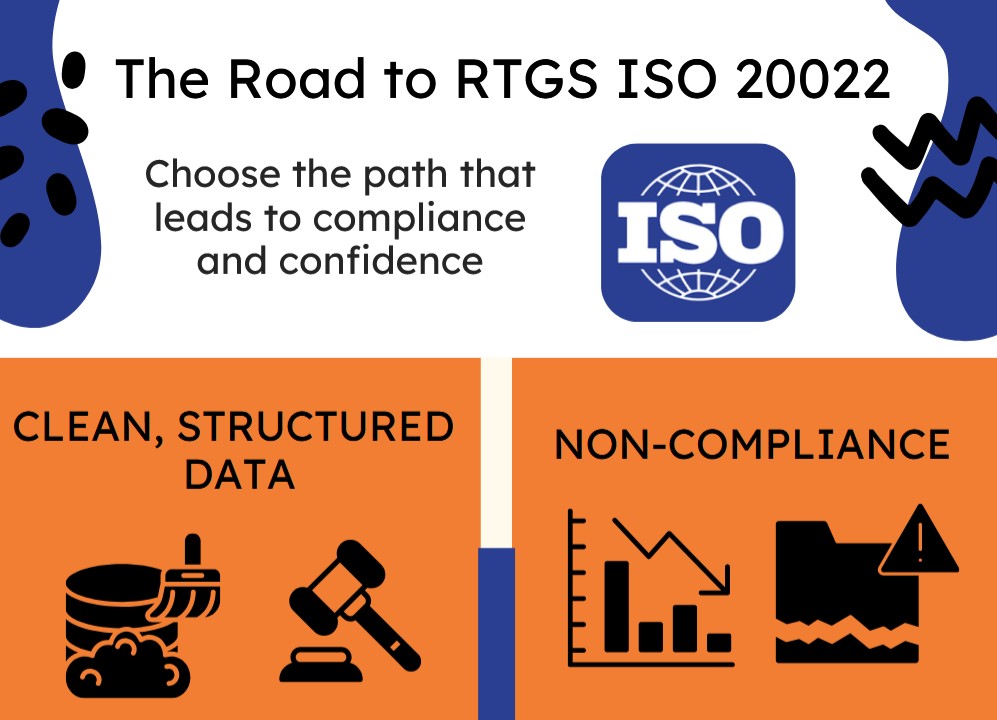
The Real Cost of Poor Data
The impact of poor-quality customer and business data stretches far beyond regulatory compliance.
Inaccurate or inconsistent address records can lead to:
- Failed communications
- Delayed payments
- Increased manual processing
- Higher operational costs
- Poor customer experiences
- Increased compliance risk
- Duplicate customer records across systems
Many organisations only recognise these issues when a major transformation project begins.
Whether that’s ISO 20022, a CRM migration, a customer data platform implementation, or an AI initiative, the outcome is often the same: the technology exposes weaknesses that have existed in the data for years.
ISO 20022 Isn’t Just a Payments Initiative
One of the biggest misconceptions surrounding ISO 20022 is that it’s solely a banking project.
In reality, it represents a broader shift towards structured, trusted and interoperable data.
The same principles that support modern payment messaging also support:
- Customer onboarding
- Fraud prevention
- Regulatory reporting
- Data governance programmes
- Customer experience initiatives
- Analytics and business intelligence
- Artificial intelligence and automation projects
Organisations investing in data quality today are not simply preparing for the next ISO 20022 milestone. They’re building stronger foundations for every business process that depends on accurate information.
The Opportunity Hidden Within the Delay
It’s easy to view a deadline extension as a reason to pause.
Forward-thinking organisations will see it differently.
The delay creates an opportunity to address longstanding data quality issues before they become business-critical.
Now is the time to:
- Review customer and supplier address quality
- Identify incomplete or outdated records
- Standardise address formats across systems
- Remove duplicate customer data
- Implement address validation at the point of capture
- Establish ongoing data quality monitoring
Organisations that take these steps now will be better prepared not only for future ISO 20022 requirements, but also for wider digital transformation programmes.
Why Data Quality Remains a Strategic Priority
The lesson from the RTGS delay is clear.
The biggest barrier to transformation is often not technology, infrastructure or regulation.
It’s the quality of the data that underpins everything.
The organisations that succeed over the coming years will be those that treat data as a strategic asset rather than an operational afterthought.
Because whether you’re preparing for ISO 20022, adopting AI, modernising your CRM or improving customer experience, success depends on having accurate, trusted and structured information.
How Hopewiser Can Help
At Hopewiser, we help organisations take control of their data through address validation, data cleansing, suppression and enrichment services.
By improving the quality, accuracy and consistency of address data, businesses can reduce risk, improve operational efficiency and build stronger foundations for future initiatives.
The RTGS deadline may have moved.
But the message remains the same.
Data quality is no longer a nice-to-have.
It’s a business requirement.
And as the recent delay demonstrates, even the most ambitious transformation programmes can only move as fast as the quality of the data behind them.
Contact Us to get started!